
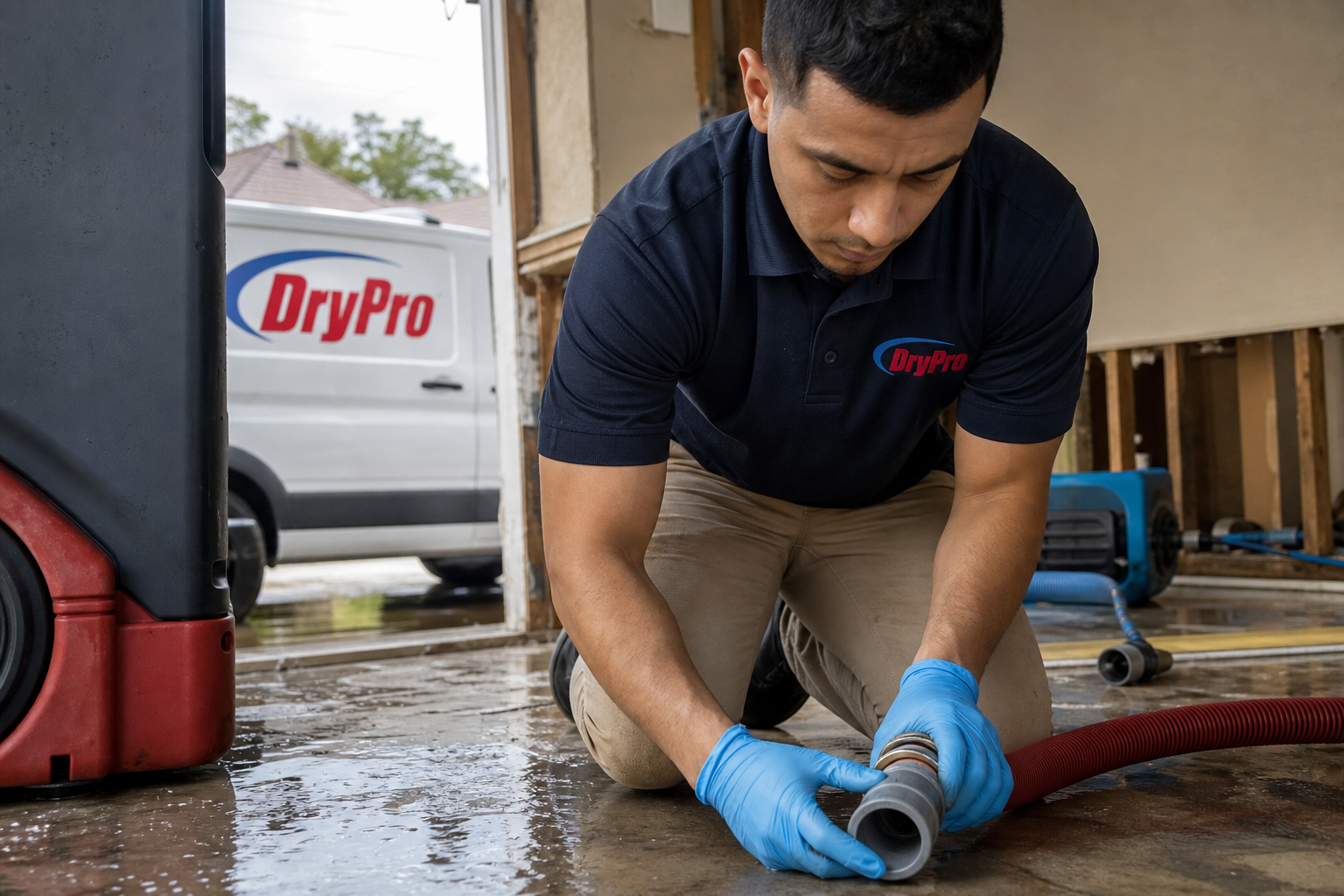
Written by DryPro | Published on June 2025
Water damage restoration typically takes 3 to 7 days for most homes, though serious cases involving structural damage or mold can stretch to 2 to 4 weeks. The exact timeline depends on water volume, affected materials, and how quickly the drying process begins.
In this guide, we break down each phase of the restoration process, what slows things down, and what homeowners in Lebanon, Mason, West Chester, Centerville, and across the greater Cincinnati area can realistically expect.
Understand the Phases of Water Damage Restoration
Restoration is not one single task. It is a multi-phase process, and each phase has its own timeline. Knowing what happens at each step helps you set realistic expectations and plan accordingly.
- Emergency Response (Day 1): A crew arrives, assesses the damage, and begins water extraction. Fast response in the first 24 hours dramatically reduces total restoration time.
- Water Extraction (Day 1): Industrial pumps and wet vacuums remove standing water. This step usually takes a few hours depending on volume.
- Drying and Dehumidification (Days 1-5): High-powered air movers and dehumidifiers run continuously. This is the longest phase for most jobs.
- Cleaning and Sanitizing (Days 3-5): Affected surfaces are cleaned, antimicrobial treatments are applied, and odors are addressed.
- Repairs and Reconstruction (Days 5-21+): Drywall, flooring, cabinetry, or structural elements are repaired or replaced as needed.
DryPro follows this structured process on every job, whether it is a burst pipe in a Mason kitchen or a flooded basement in Springboro.
Compare Typical Timelines by Damage Category
The Institute of Inspection Cleaning and Restoration Certification (IICRC) classifies water damage into categories and classes. These directly determine how long restoration takes.
| Damage Class | Description | Estimated Timeline |
|---|---|---|
| Class 1 | Minimal absorption, small area affected | 2 to 3 days |
| Class 2 | Significant absorption in walls or carpets | 3 to 5 days |
| Class 3 | Saturation from above, ceilings, walls, floors | 5 to 7 days |
| Class 4 | Deep saturation in concrete, hardwood, or plaster | 7 to 21+ days |
Most residential jobs in areas like Loveland, Landen, and Maineville fall into Class 2 or Class 3, meaning a typical restoration runs about 3 to 7 days before reconstruction begins.
Water source also matters. Clean water from a broken supply line is easier and faster to remediate than grey or black water from a sewage backup, which requires full sanitization protocols.
Identify What Slows Down the Restoration Timeline
Several factors can push a 5-day job closer to 3 weeks. Being aware of these helps you avoid preventable delays and ask the right questions when hiring a restoration company.
- Delayed response: Every hour water sits, it absorbs deeper into materials. A 12-hour delay can turn a Class 2 situation into a Class 3 or 4.
- Hidden moisture: Water migrates behind walls, under subflooring, and into crawl spaces. Thermal imaging and moisture meters are needed to find it all.
- Mold growth: Mold can begin growing in 24 to 48 hours in Ohio’s humid summers. If mold is found, remediation adds time before restoration can continue.
- Insurance documentation: Some jobs pause while waiting for an adjuster to inspect the property. Working with a restoration company experienced in insurance claims speeds this up.
- Material type: Hardwood floors, plaster walls, and concrete foundations dry much more slowly than carpet and standard drywall.
- Structural damage: If joists, beams, or load-bearing walls are compromised, permits and structural assessments may be required before repairs begin.
Homes in older parts of Lebanon, Morrow, and Miamisburg sometimes have plaster walls or original hardwood floors, which can extend drying times compared to newer construction in Liberty Township or West Chester.
Review Drying Time by Material Type
Not all building materials dry at the same rate. Understanding this helps you know why your restoration company cannot simply pull the equipment after two days and call it done.
| Material | Average Dry Time | Notes |
|---|---|---|
| Carpet and pad | 1 to 3 days | Pad is usually replaced; carpet may be saved |
| Standard drywall | 3 to 5 days | Severely saturated sections are often removed |
| Hardwood flooring | 7 to 21 days | Requires careful low-temperature drying systems |
| Concrete slab | 7 to 28 days | Specialty desiccant equipment often required |
| Plaster walls | 10 to 28 days | Common in older Lebanon and Morrow homes |
| Insulation (fiberglass) | Usually replaced | Rarely worth drying; removed and reinstalled |
DryPro uses professional moisture meters and thermal imaging cameras on every job to verify that materials have reached their drying goals before equipment is removed. This prevents secondary damage and mold growth down the road.
Explore How Local Conditions Affect Restoration in Southwest Ohio
Southwest Ohio’s climate plays a real role in how long water damage restoration takes. The region experiences hot, humid summers and cold, wet winters, both of which create challenges for drying.
During summer months in Kettering, Centerville, and Dayton-area communities, ambient humidity can be 70 to 90 percent outdoors. High outdoor humidity slows evaporation inside the structure and puts more demand on dehumidifiers.
Winter water damage, often from frozen and burst pipes, presents a different challenge. Cold temperatures slow microbial growth, which is helpful, but they also slow drying times for porous materials like wood and drywall.
Spring flooding from heavy rain is common in the Little Miami River corridor, affecting communities like Loveland, Morrow, and Maineville. Basements and crawl spaces in these areas may require pump-out followed by extended drying periods due to high groundwater and saturated soil around the foundation.
Working with a local company like DryPro means you get a crew that understands these regional conditions and adjusts equipment settings and staging accordingly.
Understand the Reconstruction Phase Timeline
Once drying is complete and the structure is verified dry, reconstruction begins. This phase is separate from mitigation and is often handled by the same restoration company or a contractor they work with.
- Minor repairs (1 to 3 days): Patching drywall, repainting walls, replacing baseboards or trim.
- Moderate repairs (3 to 7 days): Replacing sections of drywall, installing new flooring, repairing subfloor sections.
- Major reconstruction (2 to 6 weeks): Full room rebuilds, replacing cabinetry, structural repairs, electrical or plumbing work behind walls.
Permit requirements in Butler County, Warren County, and Montgomery County may add a few days to the timeline for larger jobs. Your contractor will handle permit applications, but approval windows vary by municipality.
West Chester Township and Liberty Township have busy permit offices due to high construction volume in the area. Scheduling reconstruction quickly after drying is complete helps avoid permit backlog delays.
FAQs on How Long Does Water Damage Restoration Take
Can I stay in my home during water damage restoration?
In many cases, yes. If the damage is contained to one area like a bathroom or basement, the rest of the home may be livable. If there is mold, sewage contamination, or structural damage, temporary relocation may be recommended for your safety.
Does water damage restoration take longer with insurance claims?
It can. Some insurance carriers require an adjuster to inspect before remediation begins, which can add 1 to 3 days. Choosing a restoration company experienced with insurance documentation, like DryPro, helps keep the process moving without unnecessary delays.
How do I know when my home is fully dry?
A professional uses moisture meters and thermal imaging to confirm moisture readings have returned to acceptable baseline levels for your specific materials. You should never rely on visual inspection alone, as materials can appear dry on the surface while holding moisture inside.
What happens if restoration takes too long or is done incorrectly?
Incomplete drying leads to mold growth, structural rot, and ongoing odor problems. These secondary issues can be more expensive than the original damage. Always verify that your restoration company provides moisture logs and a drying certificate at job completion.
How quickly should I call a restoration company after water damage?
Call within the first hour if possible. Waiting even 24 hours allows water to penetrate deeper into materials, dramatically increasing drying time and the likelihood of mold. Most reputable restoration companies, including DryPro, offer 24/7 emergency response.
Does water damage restoration always require removing drywall?
Not always. If caught quickly and moisture levels are not too high, drywall can sometimes be dried in place. However, heavily saturated drywall, drywall with mold, or drywall covering wet insulation typically needs to be removed for proper drying and sanitization.
Wrap Up and Next Steps
Most water damage restoration jobs take between 3 and 7 days to complete the drying phase, followed by another 1 to 6 weeks for reconstruction depending on the extent of damage. Acting fast, within the first hour, is the single most important thing you can do to shorten the overall timeline and reduce costs.
DryPro serves Lebanon, Mason, West Chester, Loveland, Centerville, Kettering, Springboro, Miamisburg, and every community in between with 24/7 emergency water damage restoration. Call us at (513) 984-0810 right now to get a crew dispatched and start the recovery process today.